
The administration of President Bola Ahmed Tinubu has reportedly directed federal universities across Nigeria to begin funding lecturers’ allowances through their internally generated revenue (IGR), a development that has sparked concerns over possible increases in tuition and other charges in public tertiary institutions.
This followed the emergence of an internal memo from Modibbo Adama University, which indicated that the Federal Ministry of Education instructed vice-chancellors to source funds internally for the payment of Consequential Adjustment and Transport Allowance (CATA) to academic staff.
The memo, dated May 18, 2026, and signed by the university’s bursar, Hanien N. Ayuka, disclosed that the institution had been paying the allowance from its IGR since January 2026 but could no longer sustain the arrangement due to the absence of financial backing from the Federal Government.
According to the document, the Minister of Education had directed all vice-chancellors to immediately commence payment of the allowance to eligible academic staff using internally generated funds pending federal reimbursement.
The circular stated that despite complying with the directive since January, the university had yet to receive any cash backing from the Federal Government.
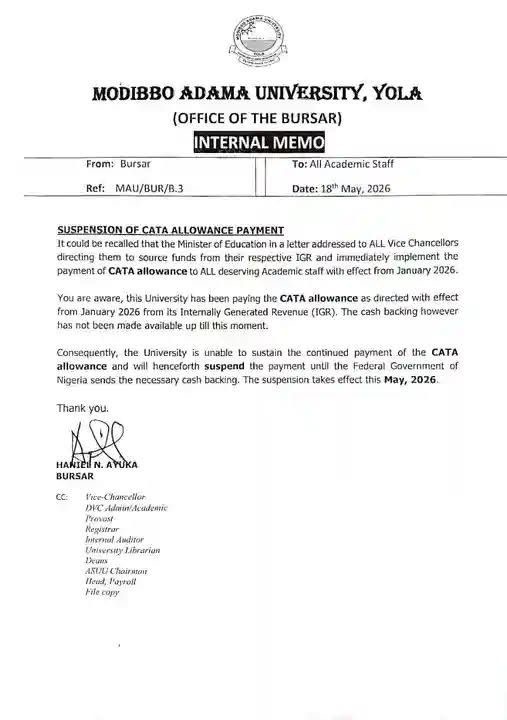
As a result, the university announced the suspension of the allowance payment effective May 2026, citing worsening financial pressure on the institution.
Copies of the memo were reportedly forwarded to key university officials, including the Vice Chancellor, Deputy Vice Chancellors, Registrar, Provost, Internal Auditor, University Librarian, deans, the chairman of the Academic Staff Union of Universities branch, and the Head of Payroll.
A lecturer at the institution, who spoke anonymously, warned that the directive could force many public universities to increase tuition fees and service charges in order to survive financially.
According to the source, universities are struggling to sustain statutory payments without direct federal support, leaving managements with limited options.
“The reality is that many universities may have no choice but to increase tuition and other charges next session because the government has effectively pushed the responsibility of funding onto the institutions,” the lecturer reportedly said.
The development has generated anxiety among students, parents, and lecturers who fear that another round of fee hikes could worsen the economic hardship already facing many Nigerian families.
In recent years, several federal universities have reviewed upward their tuition and administrative charges, leading to protests by students and labour unions who accused the government of gradually commercialising public education.
Meanwhile, ASUU has again accused the Federal Government of failing to properly implement the 2025 ASUU/FGN agreement, warning that the situation could trigger another industrial crisis in the university system.
Speaking during a press conference at Benue State University, the ASUU Nsukka Zone Coordinator, Comrade Christian Opata, alleged that the government had only partially implemented the agreement signed on January 14, 2026.
Opata criticised the failure to inaugurate the Implementation Monitoring Committee, which was expected to oversee compliance with the agreement and address possible bottlenecks.
The union also faulted the Federal Government over the proposed National Research and Innovation Development Fund (NRIDF), announced by the Minister of Education, Dr. Maruf Alausa, alleging that ASUU was excluded from the process despite being a party to the agreement.
ASUU further rejected the proposed funding structure for the research fund, insisting that it contradicted the agreement which recommended that at least one per cent of Nigeria’s Gross Domestic Product (GDP) be allocated to research, innovation, and development.
The union warned that continued failure to fully implement the agreement could push lecturers toward another round of industrial action in Nigeria’s public universities.