

By Nworisa Michael
The tragic death of 25-year-old Abuja-based singer, Ifunanya Nwangene, popularly known as Nanyah, has continued to spark national conversation not merely because of how she died, but because of what her death reveals about Nigeria’s emergency healthcare system, even in the nation’s capital.
In the days following reports that the young artiste died after a snakebite due to the alleged unavailability of anti-venom in Abuja hospitals, the Federal Medical Center (FMC) have issued statements debunking claims that she was turned away or denied treatment. While these clarifications are important and should be noted, they do not erase the deeper and more troubling issue her death has brought to the fore: the fragility of emergency medical response in the Federal Capital Territory (FCT).
At the centre of this tragedy is a young woman who, by multiple accounts, made desperate efforts to save her life. Whether anti-venom was outright unavailable, delayed, inaccessible, or poorly coordinated, one fact remains unchanged a preventable medical emergency ended in death.
Snakebites are not rare occurrences in Nigeria, and anti-venom is a basic, life-saving medical necessity. The FCT, which hosts Nigeria’s seat of power, should represent the gold standard of healthcare preparedness. Yet, this incident has exposed how even in Abuja, emergency systems can fail the most vulnerable at the most critical moment.
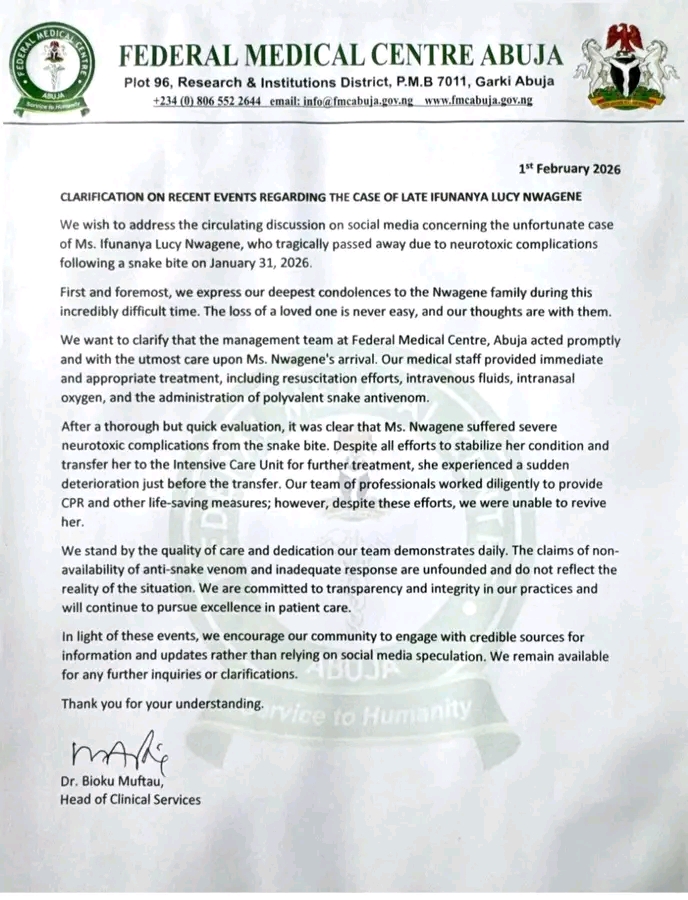
Beyond institutional rebuttals and counter-statements, the human reality must not be lost:
A young Nigerian with talent, promise, and a future did not survive an emergency that modern healthcare systems are designed to manage.
Public outrage and grief that followed her death should not be dismissed as misinformation or emotional overreaction. They reflect a collective fear shared by millions of Nigerians that in moments of crisis, access to timely, effective medical care is still uncertain, regardless of location.
This incident must therefore serve as an urgent wake-up call.
The Federal Government, FCT Administration, and health authorities owe Nigerians more than denials. They owe the public:
1. Transparent disclosure of emergency preparedness levels in public and private hospitals
2. Clear protocols for handling snakebite and other acute emergencies
3. Guaranteed availability and distribution of essential life-saving drugs
4. A coordinated emergency response system that works in real time, not on paper
If a 25-year-old woman can die from a treatable condition in Abuja, then the system is not merely strained it is dangerously inadequate.
Ifunanya “Nanyah” should not be remembered only as a singer who died young, but as the face of a national healthcare conversation that must lead to reform, accountability, and action.